National motto
Unity and Faith, Peace and Progress
Adopted in 1978. Before that, from 1960–1978, the motto was “Peace, Unity, Freedom”.
The words sit on the ribbon at the base of the coat of arms. See the coat of arms.
National identity
A country of many languages and landscapes, bound by shared symbols — a flag, a motto, an anthem, and a coat of arms.
National motto
Adopted in 1978. Before that, from 1960–1978, the motto was “Peace, Unity, Freedom”.
The words sit on the ribbon at the base of the coat of arms. See the coat of arms.
The flag
Designed by Michael Taiwo Akinkunmi in 1959. First flown as the national flag on 1 October 1960.
Coat of arms
Adopted 20 May 1960, just before independence.
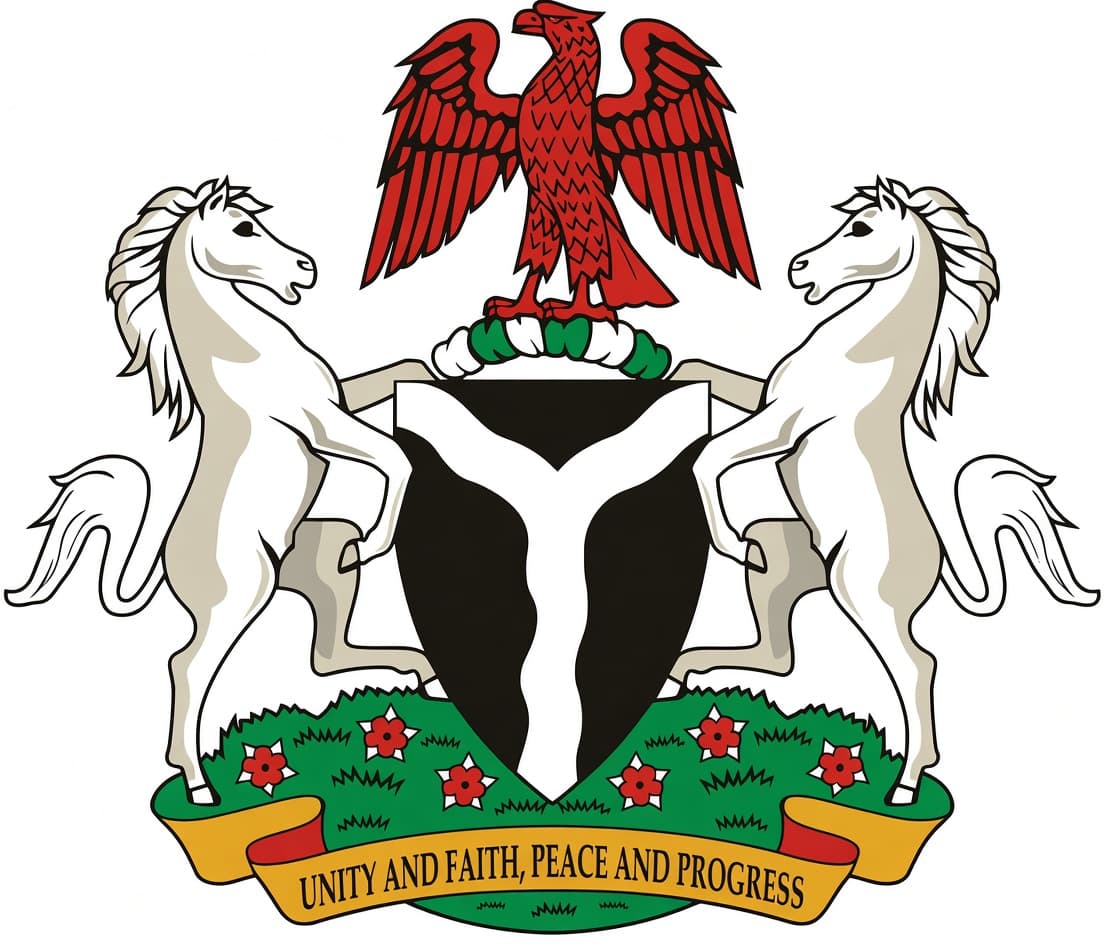
Black shield
Nigeria’s fertile soil
Wavy white Y
The Niger and Benue rivers meeting at Lokoja
Two white horses
Dignity
Red eagle
Strength
Green and white wreath
The colours of the flag — agriculture and peace
Costus spectabilis
The national flower; it grows across the country and stands for beauty
Ribbon
The national motto since 1978
National anthem
National anthem since 29 May 2024. First used from 1 October 1960 to 1 October 1978. Words by Lillian Jean Williams; music by Frances Benda. It replaced Arise, O Compatriots (1978–2024).
Stanza I
Nigeria, we hail thee, Our own dear native land, Though tribes and tongues may differ, In brotherhood we stand, Nigerians all, are proud to serve Our sovereign Motherland.
Stanza II
Our flag shall be a symbol That truth and justice reign, In peace or battle honoured, And this we count as gain, To hand on to our children A banner without stain.
Stanza III
O God of all creation, Grant this our one request: Help us to build a nation Where no man is oppressed, And so with peace and plenty Nigeria may be blessed.
The National Pledge · Felicia Adebola Adeyoyin, 1976
I pledge to Nigeria my country,To be faithful, loyal and honest,To serve Nigeria with all my strength,To defend her unity and uphold her honour and glory.So help me God.
History
The long story lives on the timeline. This is the short version — how the country took its present shape.
1914
On 1 January 1914 Britain joined the Northern and Southern Protectorates (and the Colony of Lagos) into a single Nigeria. The land already held kingdoms, city-states and communities — from Benin and Kanem-Bornu to the Hausa cities, Yoruba states and the Niger Delta.
1960
On 1 October 1960 Nigeria became independent. Sir Abubakar Tafawa Balewa was Prime Minister. The capital was Lagos.
1963
On 1 October 1963 Nigeria cut its last constitutional tie to the British Crown. Nnamdi Azikiwe became the first President.
1967–1970
A civil war ran from 6 July 1967 to 15 January 1970. When it ended, Head of State Yakubu Gowon spoke of “no victor, no vanquished,” and the work of rebuilding began.
1991
On 12 December 1991 the seat of the federal government moved from Lagos to Abuja. The Federal Capital Territory itself had been created in 1976 as a planned city in the centre of the country.
1999
After years of military government, Nigeria returned to elected civilian rule on 29 May 1999. Olusegun Obasanjo was sworn in as President.
Today
Thirty-six states and the Federal Capital Territory. More than 500 living languages. A young population, and the same question the motto asks: how to hold unity, faith, peace and progress together.